
Precision analysis for early detection of recurrence.
Our AI-based prognostic test reduces over-treatment and under-treatment of early-stage breast cancer. Empowering clinicians with data-rich insights.
DCIS Prognostic Test
Reduces unneeded surgery. Identifies early-stage risk.
FDA Clearance PendingAbout Predictoma
We provide accurate information about whether early breast cancers are dangerous and need prompt treatment, or are non-dangerous and would not impact the patient's life.
Our Mission
Developed by years of research in Dr. Petty's lab combined with AI expertise of Dr. Saatchi. Our tests give physicians better, more accurate information to guide treatment and improve care.
DCIS Focus
Our first test targets early breast cancer (DCIS). It reduces unneeded surgery and suffering for non-dangerous lesions and identifies women who need surgery at an early point.
Scientific Foundation
Our AI test is grounded in peer-reviewed research, including a retrospective case-control trial and a new understanding of cancer recurrences. It is exceptionally accurate and free of racial bias.
For technical details, see our publications or contact Howard Petty (howard@predictoma.com).
Advanced AI Analysis & Biomarker Mapping
Better, more accurate information to guide treatment decisions and improve patient care. Our proprietary neural network processes high-resolution micrographs to identify subtle patterns in cellular architecture.
AI-Powered Prognostic Test
Advanced machine learning for accurate DCIS prognosis using glycolytic enzyme trafficking analysis.
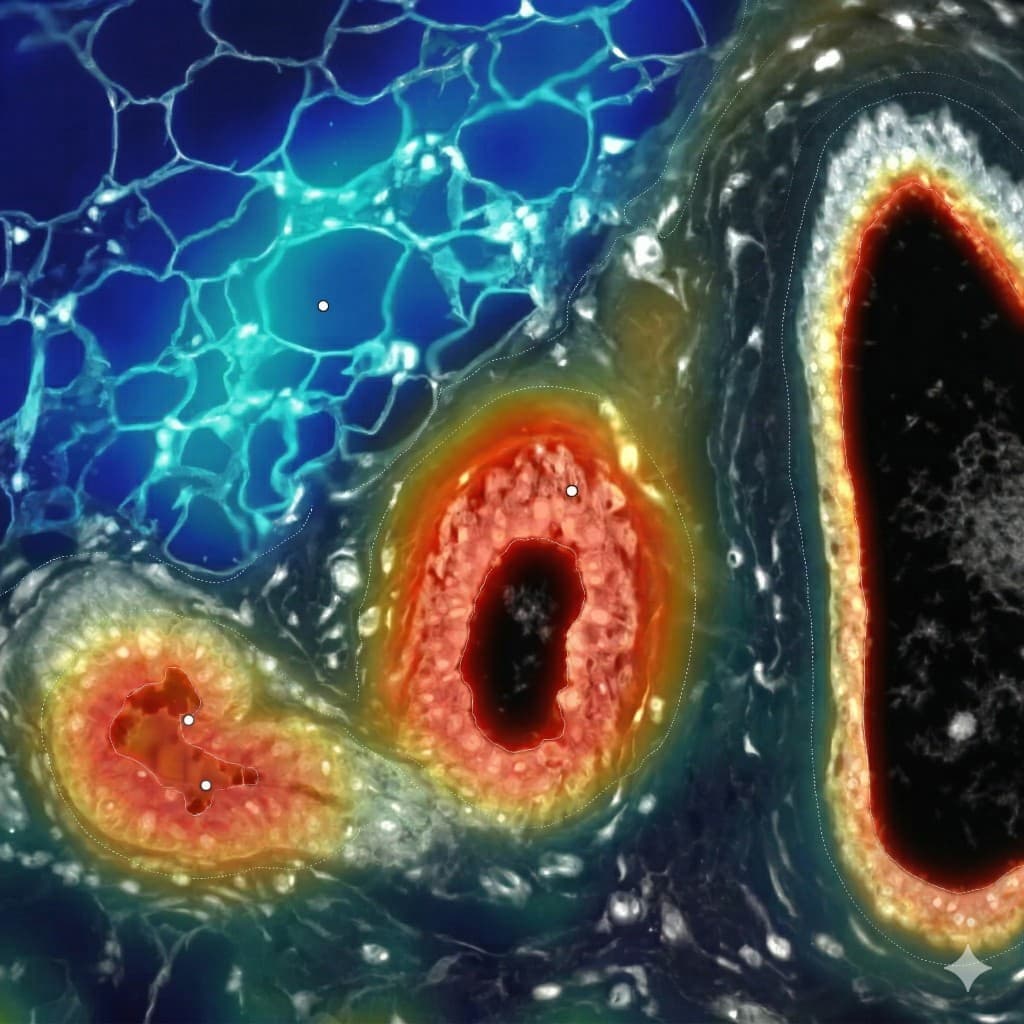
Activity Heatmapping
Visualizing metabolic gradients to pinpoint hotspots of cellular stress or transformation.
Exceptionally Accurate
Peer-reviewed algorithms accurate across all patient demographics, free of racial bias.
Live Process Overlay
AI engine identifying glycolytic enzyme co-clustering patterns in DCIS tissue.
Advanced Cancer Detection Platform
Better, more accurate information to guide treatment decisions and improve patient care.
AI-Powered Prognostic Test
Advanced machine learning for accurate DCIS prognosis
HIPAA Compliant
Enterprise-grade security and full regulatory compliance
Peer-Reviewed Research
Based on published research and clinical trials
No Racial Bias
Exceptionally accurate across all patient demographics
Future Expansion
Breast cancer is our starting point. We will expand to other early-stage, non-invasive cancers:
We hope to change how early stage cancers are managed.
7+
Peer-Reviewed Publications
200+
Career Publications
20+
Lifetime Patents by Dr. Petty
100%
HIPAA Compliant
Our Team
Leading researchers in cancer detection and AI
Dr. Howard Petty
CEO & Founder
Dr. Petty recently retired from the University of Michigan to work full time with Predictoma. He has worked extensively on breast cancer and the mechanisms of recurrences, and is a leader in applied microscopy and AI-based recurrence prediction.
Ph.D. from Harvard in Biophysics; Damon Runyon fellow at Stanford. Serial inventor with over 200 publications and 20 patents.
Research & Publications
Grounded in peer-reviewed published scientific research
Computer vision identifies recurrent and non-recurrent ductal carcinoma in situ lesions with special emphasis on African American women
Saatchi Y, Schanen P, Cheung RA, Petty HR
The American Journal of Pathology 2023
https://doi.org/10.1016/j.ajpath.2023.05.018What applied physical chemistry can contribute to understanding cancer: Toward the next generation of breakthroughs
Schanen P, Petty HR
AppliedChem 2023, 3, 378–399
https://doi.org/10.3390/appliedchem3030024Using machine vision of glycolytic elements to predict breast cancer recurrences
Petty HR
Metabolites 13 (1):41, 2023
https://doi.org/10.3390/metabo13010041Prognostic evaluation of ductal carcinoma in situ lesions using monoclonal antibodies and machine learning
Petty HR
Handbook of Cancer and Immunity, Springer-Nature, Switzerland AG, (N. Rezaei, Ed.)
https://doi.org/10.1007/978-3-300-80962-1_318-1Additional publications
Enzyme trafficking and co-clustering precede and accurately predict human breast cancer recurrences: an interdisciplinary review
Am J Physiol Cell Physiol., 322: C991-C1010, 2022
Relocation of phosphofructokinases within epithelial cells is a novel event preceding breast cancer recurrence that accurately predicts patient outcomes
Am J Physiol Cell Physiol. 321: C654-670, 2021
Spatial locations of certain enzymes and transporters within preinvasive ductal epithelial cells predict human breast cancer recurrences
Am J Physiol Cell Physiol. 319: C910-921, 2020
Frequently Asked Questions
Common questions about Predictoma and the DCIS prognostic test
What is Predictoma?
Predictoma is an AI-powered prognostic test for ductal carcinoma in situ (DCIS), an early form of breast cancer. Our test helps physicians determine whether a DCIS lesion is likely to recur or remain harmless, reducing unnecessary surgery while identifying women who need prompt treatment.
What is DCIS?
DCIS (ductal carcinoma in situ) is a non-invasive breast cancer where abnormal cells are confined to the milk ducts. While many DCIS lesions never become dangerous, some can progress to invasive cancer. Predictoma uses AI and peer-reviewed research to predict which cases need treatment.
How does the Predictoma DCIS prognostic test work?
Our test combines computer vision and machine learning with discoveries about glycolytic enzyme trafficking in breast tissue. Based on peer-reviewed research in The American Journal of Pathology and other journals, we analyze tissue samples to predict recurrence risk with high accuracy across all patient demographics.
Is Predictoma HIPAA compliant?
Yes. Predictoma is designed for HIPAA compliance with enterprise-grade security, encryption, and audit logging. We process protected health information only as a Business Associate under appropriate agreements.
Is Predictoma FDA cleared?
Predictoma is pending FDA clearance. Our technology is based on published peer-reviewed research. Contact us for the latest regulatory status.
Contact Us
Technical information and collaboration opportunities
Technical Inquiries
For detailed technical information, contact Dr. Howard Petty.
howard@predictoma.com